

On paper, Noorindah Iskandar is an unlikely figure to emerge as one of Singapore’s boldest voices in sexual wellness.
A 42-year-old woman navigating a society where sex remains taboo and Malay identity is often bound up with religious expectations, Noorindah is the founder of Shyandcurious.com, where conversations around swinging, sex toys and desire are approached with unusual candour.
Her entry into sexual wellness stemmed not from rebellion, but from a family tragedy.
In October 2019, her mother died suddenly from breast cancer, after keeping her diagnosis hidden from her loved ones until it was too late. The silence, Noorindah would later realise, was not unusual. Shame, modesty and a deeply ingrained sense of privacy had kept her mother from speaking openly about her own body.
“She was never officially diagnosed until she was admitted into the hospital for pneumonia, and passed away four days later. In the hospital, she confessed that she was ashamed of her body and felt it was too private to reveal her discovery even to her own daughters,” shares Noorindah, who credits her liberal outlook to her years living and working in New York in her twenties.
“What struck me was that her hairdresser had known all along and kept urging her to tell us, but my mother was too afraid.”
The experience left her grappling with a question that would eventually shape her work: why are the most intimate, life-altering realities — our bodies, our health, our relationships — often the hardest to talk about with the people closest to us?
A year later, in October 2020, the former digital marketing consultant launched Shyandcurious.com, a space designed to do the opposite. Part personal journal, part cultural intervention, the platform invites candid conversations around sex, intimacy and the body, grounded in lived experience rather than clinical detachment. It was built on a simple but radical premise: that no question, however awkward or taboo, should feel too “stupid” to ask.
When she first shared the idea for Shy & Curious with friends, the reactions were mixed. Some were immediately supportive, recognising how it drew on her strengths as both a writer and marketer. Others were far less convinced.
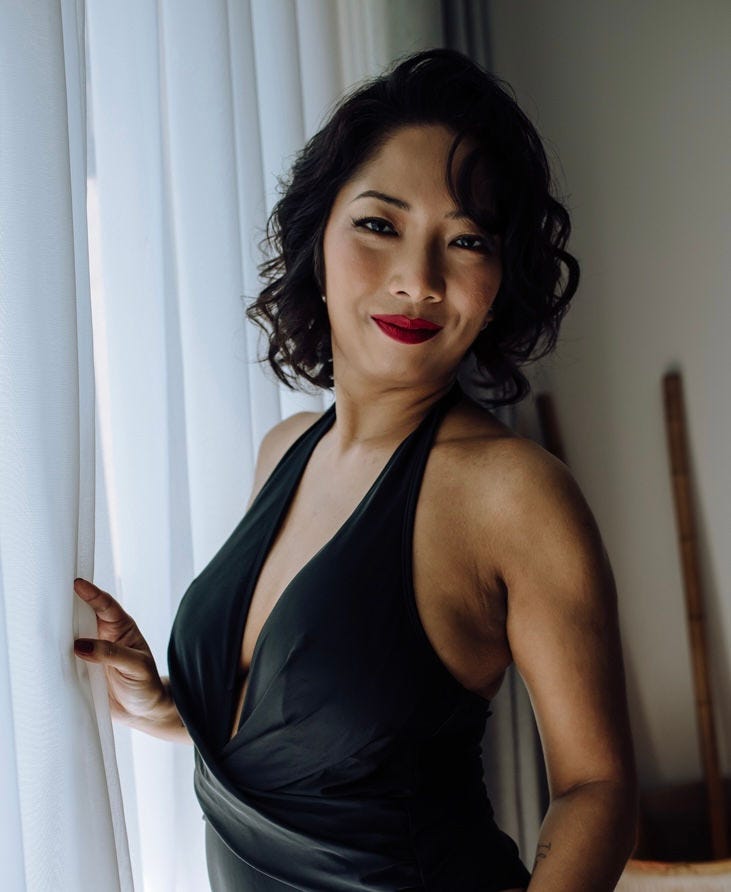
“A few of them told me I was committing both career and social suicide,” she recalls.
Ironically, for someone who has built a platform around intimacy and connection, Noorindah remains unattached today.
“My dating life is pretty much D.O.A.,” she says, with characteristic candour. “When I started the platform, I was in a serious relationship, so I didn’t expect to be single and dating less than half a year later.”
As a long-time observer of her work and a believer that she is pushing the conversation forward in a way few others in Singapore are, GlowEdit.io recently caught up with Noorindah for an email interview.
What internal negotiations did you have to go through before speaking publicly about sex?
The main and only consideration I made right at the start of my journey was to use my real name and face for the platform. If I was advocating for honesty and vulnerability from others about the taboo, how hypocritical would it be if I went by a pseudonym or remained hidden? Once I’d set the intention to be public with my name, it also meant I was fully invested and can’t give up easily despite whatever obstacles might be in the way. It was my personal check and balance!
How did people respond when you first stepped into this space, and what surprised you most?
On launch day, I was really surprised and touched by the positive response I was getting from the public with my first guest appearance on the Something Private podcast. It was during the Covid lockdown, when a growing community of self-love and sexual wellness advocates was also gaining momentum on Instagram. What meant the most to me, though, was hearing from other Malay men and women who said the posts resonated deeply. They were grateful not only for a safe resource they could turn to without guilt, but also for a writer who understood the cultural nuances and beliefs at play.
Has there been a personal cost to being publicly sex-positive?
Ironically, openly admitting to looking for love in my late 30’s to now has greatly helped the platform. My personal essays about my dating experiences are the articles that get the most engagement and feedback from fellow singles as they feel so seen. I’m always upfront with whoever I meet and date that I write about my love life but I make it a point to keep it anonymous and fudge details so that they’re unidentifiable. On some days, I tire of the navel-gazing, ‘pick-me’ undertones of it all, but on the whole, I rather like the Carrie Bradshaw comparisons. Clichéd as it may sound, writing about my love and sex life has helped me process it with each partner.
If you could dismantle one deeply ingrained belief about sex here, what would it be and why?
That it’s so serious. I think we have inadvertently put sex on a pedestal and, in doing so, made it harder to foster truly inclusive, sex-positive education and a healthier culture of consent. So much of how we think about sex is shaped by culture and social conditioning, but beyond its biological function, sex is also about connection, pleasure and play between consenting adults. When it is treated as both forbidden and transactional — and layered with shame, fear and guilt around seeking knowledge or sharing experiences —that’s when we end up with the darker side of repression, trauma and crime.
What conversations about sex in Southeast Asia still feel almost “untouchable”?
Definitely how race and religion can play a factor in sex and dating are topics that I have to be mindful about. They’re always tricky subjects no matter where in the world you are but as an obvious brown Muslim Southeast Asian woman, I’m very aware of the impact I make from my choice of words and topics.
While I try not to succumb to social pressure, my litmus test is if a certain article or essay will alienate the very audience I aim to reach. My readers are those who might be more conservative and introverted but still curious and seeking answers to questions they’re too afraid to ask. If the platform becomes too risqué or polarizing, they might not feel as comfortable to use it as a safe space and resource. For example, I might write about Ethical Non-Monogamy but I wouldn’t write a blow-by-blow account (pun intended) about being a unicorn in a threesome.
Where do you see the biggest silence today: unmarried individuals, married couples, men, women? Please elaborate.
Definitely men. While it’s true that I get my fair share of unsolicited dick pics and trolls in my DMs, I also get genuine questions and concerns from men about their bedroom performance and relationship woes. You’ll be surprised at how innocent and genuine some of these questions are, whether it’s admitting they’re not satisfying their partners, or how to re-ignite a conversation with someone whose interest is fading.
What they often share is an inability to be vulnerable with friends, coupled with the sense that their struggles are not serious enough to warrant professional help. That stoic, “I’ll deal with it myself” mindset only deepens male loneliness.
That said, some also assume that because I speak so openly about sex and dating, they are entitled to direct access to me. As a result, I have had to set clearer boundaries around both my online persona and the time I devote to such requests.
What patterns do you notice in the questions people ask you privately that they would never say publicly?
Interestingly, women will ask the more intense graphic questions involving anatomy, casual sex and sex toys, whereas men will ask more emotionally-driven questions like how to keep their partner’s interest or even how to flirt! I find it very amusing and telling about what we’re truly dealing with behind closed doors when you have a safe space to vent.
How do you interpret the pace at which sexual narratives are evolving online compared to how individuals are actually processing intimacy emotionally?
Especially with the algorithm and me being in a sexual wellness bubble as an educator, it’s easy to assume that people are becoming more open-minded and informed about sex and consent culture. But one look at the comments on public forums or even Facebook whenever there’s a news article related to sex, there’s still shame, judgement and very conservative viewpoints from the majority.
I’ve worked alongside Gen Z and what’s interesting is that while they might appear to be more aware of the diversity of sexual narratives, they are rather hesitant about emotional intimacy and feel more than they let their nonchalant demeanour appear. So while I feel like while we’ve certainly made progress along the years, there’s still work to be done in this space.
How do men struggle in this space, in ways that are rarely acknowledged?
Men have long been cast as both the initiators of sex and the arbiters of their partner’s pleasure. It is a social script many grow up with, reinforced by the media. On one hand, that places immense pressure on men who may be dealing with shifts in libido, performance issues, or simply not prioritising sex in the way they feel they are expected to. On the other, it can leave some men taking full ownership of their partner’s sexual satisfaction, and feeling threatened when that satisfaction is discussed openly, whether through communication or the introduction of sex toys. They may interpret this as a personal critique of their performance or masculinity, and react by shaming or alienating their partners for stepping outside more passive ideas of femininity.
How should sexual wellness be reframed in the context of ageing?
I’m learning this myself as I’ve hit my 40’s and from my married friends experiences! As most of them put it, life gets in the way and sex becomes less of a priority compared to careers, kids and caregiving. There’s only so much energy you have left for yourself, let alone your partner. Sex can become more routine and less intriguing.
As I navigate perimenopause, changes in my body and in the dating landscape have naturally slowed my sex life. In my younger years, I may have valued novelty and experimentation; now, I’m drawn more to the slow burn of connection and emotional safety. It has made me more aware of how my body and hormones work, and of the importance of tending to my sexuality through both self-pleasure and emotional connection.
Just as ageing makes us more conscious of the training, supplements and preventive care we need, I believe sexual wellness deserves a place on that list too. It is something we should approach with the same grace and kindness we afford the rest of our changing selves.
Were there role models, mentors or cultural references that gave you the confidence to do this work?
The late Helen Fisher’s Why We Love was seminal for me when I was 19 and spending a year at art school. I was exploring themes of love and obsession then, partly because I had a crush on a boy for three years and kept wondering what was wrong with me. It was the first time I encountered the idea that love itself could be studied, that it was a subject worthy of inquiry, with its own framework.
Then, in my twenties, living in New York exposed me to conversations around sex in a far more open, non-judgemental context, removed from the shame and fear that often shape it culturally. I visited places like Babeland, which was pioneering in normalising sex toys, and briefly dated the owner of a swingers’ club. What fascinated me was not just the sex, but the logistics and business of running such a space. I probably spent more time picking his brain than anything else.
The other influences that really propelled me into this work were Attached: The New Science of Attachment and How It Can Help You Find – and Keep – Love by Dr Amir Levine and Rachel Heller, and Esther Perel.
How has your own understanding of sexuality evolved since you started educating others?
That we’re less alone than we think we are. For every question asked, kink explored or situation navigated, there are others who have experienced something similar…and who are often willing to share, once they feel safe enough to do so.
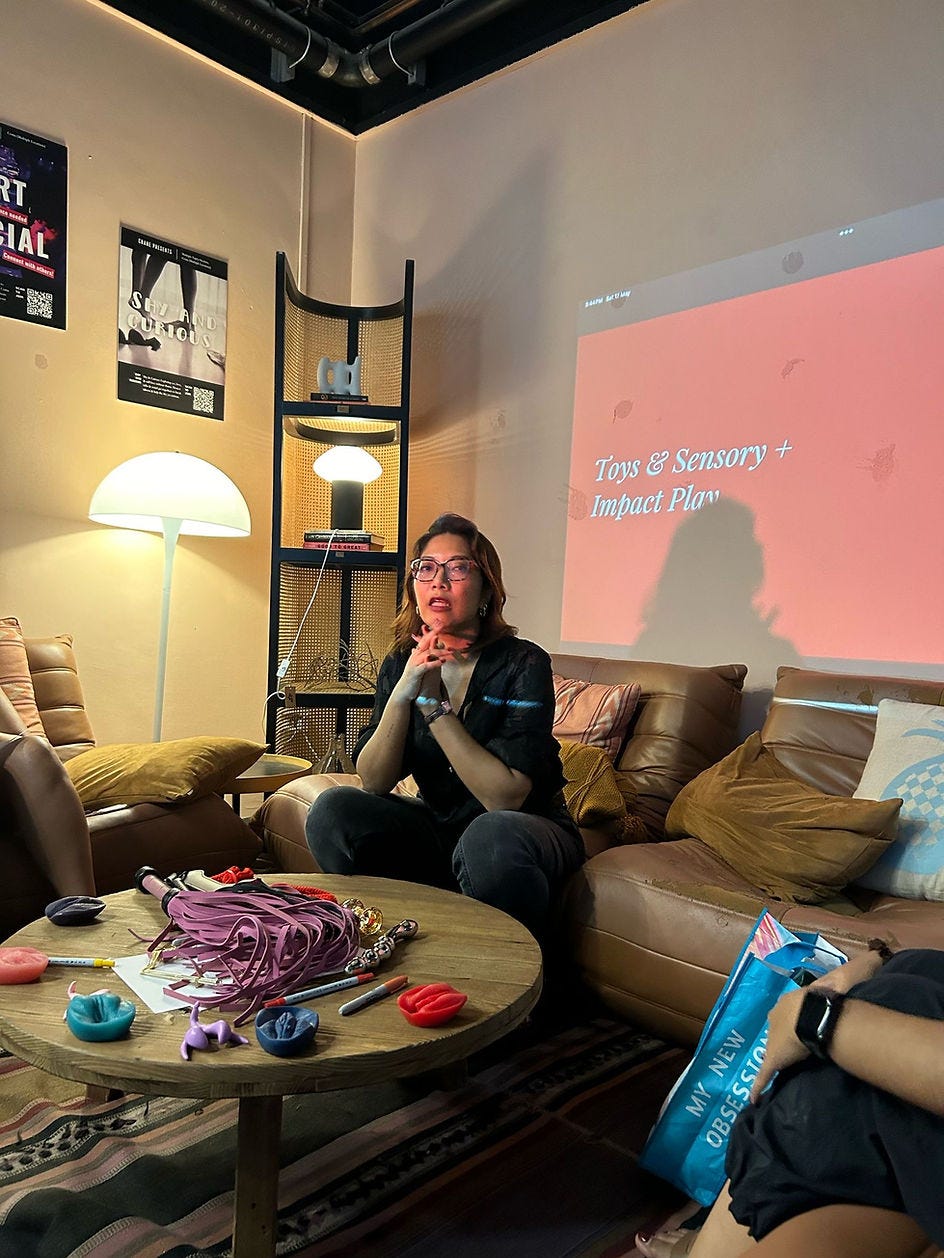
Professionally, working within the sexual wellness industry and alongside sex toy brands has also given me a deeper understanding of the business behind sex. It is never just a vibrator — it is decades of research and development, legislation, marketing and investment, all culminating in something designed to get into your pants!
If Southeast Asia were to become genuinely sex-positive, what would look different?
Less shitty uneducated comments online for one! But more broadly, I think a truly sex-positive culture would have its greatest impact on women. It would replace shame, fear and guilt with knowledge, boundaries and consent. Imagine if talking about sex did not automatically invite labels like “whore” or “deviant”. It would create more room for exploration, play and pleasure without guilt, and allow women to speak with greater confidence, without fear of being punished simply for having a voice.
What conversations do we still avoid that urgently need to happen?
An inclusive, sex-positive, consent-focused education in schools, rather than abstinence-based or fear-driven sex ed. With people choosing to stay single for longer, and with the need for education to be inclusive across the full spectrum of sexuality, we can no longer rely on teaching models rooted in older, more traditional assumptions. We cannot keep burying our heads in the sand and hoping for the best. Curiosity is natural; surely it is better for it to be met with confidence and empowerment than with fear and guilt.