

For decades, retinol has been the gold standard in skincare — clinically proven, dermatologist-backed, and notoriously difficult to tolerate. Now, a new wave of “next-generation” alternatives is flooding the market, promising everything retinol does, but better: gentler, faster, more stable, more effective. For instance, Elizabeth Arden and Aesop position their latest formulations around hydroxypinacolone retinoate (HPR), a sophisticated, skin-supportive retinoid said to rival the efficacy of retinol, while La Mer’s newest night cream substitutes traditional retinol with a marine-derived alternative, MRA-3™.
But behind the claims, a more important question emerges: are these true scientific advances or simply more sophisticated iterations of a familiar formula?


According to dermatologist Dr Angeline Yong of Angeline Yong Dermatology, the answer lies somewhere in between.
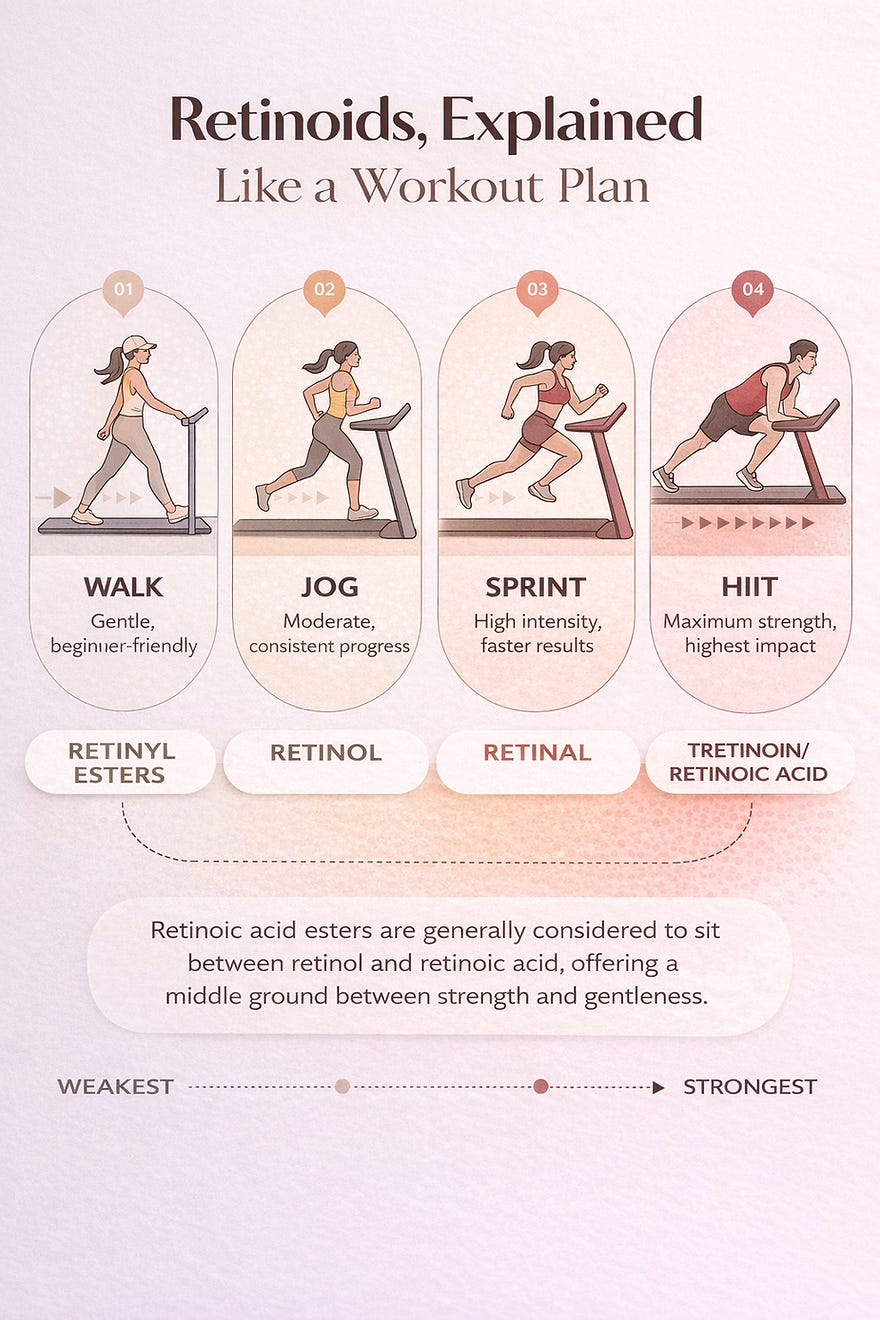
Retinoids are not a single ingredient but a spectrum of vitamin A derivatives with varying potency. The main categories are retinyl esters, retinol, retinal and retinoic acid, with the last one available only by prescription.
All retinoids must ultimately convert into retinoic acid to deliver their full effect. In general, the fewer conversion steps required, the more potent they are: retinyl esters are the gentlest, retinol sits in the middle, and retinal is closer to retinoic acid in both structure and strength, and therefore stronger but often more difficult to stabilise.
This creates what dermatologists often describe as a trade-off between efficacy and irritation. In general, the more potent the retinoid, the greater the likelihood of side effects such as redness or peeling.
Newer compounds are attempting to shift this balance.
While Dr Yong believes that some newer retinoids do reflect genuine scientific progress — particularly in prescription-grade formulations — others are marketed in ways that make them appear more revolutionary than they truly are. Hype or real deal? “The key is whether the ingredient offers a meaningful improvement,” she explains, pointing to factors such as stability, tolerability and delivery, rather than simply novelty.

Many newer formulations are designed to be gentler and more tolerable — sometimes through technologies such as encapsulation — allowing for more controlled delivery and reduced irritation.
At the same time, newer prescription retinoids may offer improved efficacy for specific concerns such as acne, while also being better tolerated than older treatments because they are designed to act more precisely in the skin.
Newer, fourth-generation retinoids like trifarotene, for instance, target specific pathways linked to acne, which allows them to work effectively with fewer side effects.
Experts have also cited hydroxypinacolone retinoate (HPR), found in formulations such as Aesop’s Resolute Facial Concentrate and Elizabeth Arden’s Retinol + HPR Ceramide Capsules, as a retinoic acid ester with dual-action potential.
Designed to act more directly on the skin with fewer conversion steps, esters like HPR and retinyl retinoate can break down into both retinoic acid and retinol, delivering an immediate effect while also providing a slower, sustained release as the retinol continues to convert. Early research suggests they may support collagen production, cell turnover and improvements in acne, pigmentation and fine lines, although long-term evidence remains less established than for traditional retinoids.
Alongside traditional retinoids, a growing number of plant-based alternatives have entered the market, offering milder, more accessible entry points into vitamin A-like skincare, particularly for sensitive skin.
Bakuchiol, one of the most widely studied examples, gained attention following a 2019 study that found it improved pigmentation and wrinkles to a similar degree as retinol, with fewer side effects such as irritation and flaking. However, because bakuchiol was applied twice as often as retinol, their efficacy is not directly comparable.
To switch or not to switch?
That said, Dr Yong notes that prescription tretinoin still has one of the strongest clinical track records, and remains the gold standard for concerns such as photoageing.
“The reason is that tretinoin is already in its active form, while retinol and many newer derivatives need to be converted in the skin before they can work fully. That often makes them easier to tolerate, but it can also mean they are less potent or slower to show results,” she explains, adding that a product that is slightly less potent but can be used consistently without significant irritation still delivers meaningful results over time.
This raises another question: if someone is already tolerating traditional retinol well, is there any real reason to switch?
“Not necessarily,” says Dr Yong. “If a current retinol or retinoid is working well and delivering results, there is usually little reason to change simply because a newer formulation is marketed as more advanced.“Traditional retinol, she notes, already has a well-established place in skincare, and many of the newer options are better understood as alternatives.
However, there are situations where switching may make sense.
“Newer formulations may offer improved texture, greater stability or a lower risk of irritation, while some are designed to feel more cosmetically elegant on the skin…factors that can make them easier to use consistently,” she says.
In the end, the real innovation may not lie in chasing the next retinoid, but in finding one you can use — and stick with.