Human-derived ECM is beauty’s buzziest new injectable. Here’s what you should know.
When I first heard about one of South Korea’s hottest new skin boosters, I had to read the description twice. Its headline ingredient wasn’t salmon DNA, exosomes or another lab-made regenerative compound, but extracellular matrix derived from donated human skin — in other words, from the tissue of someone who had died.
As unsettling as that may sound, the underlying technology isn’t new. Donated human skin has been used in reconstructive and plastic surgery for years. The tissue is processed to remove the donor’s cells, leaving behind the skin’s natural supporting framework — a mesh of collagen, elastin and other proteins known as the extracellular matrix (ECM).
In surgery, this processed tissue, known as acellular dermal matrix (ADM), is typically used as a sheet or graft to help support and repair tissue. The newer aesthetic injectables take the idea a step further: the remaining ECM is processed into tiny particles small enough to be injected into the skin through a needle.
ECM skin boosters have been available in Singapore since late last year.
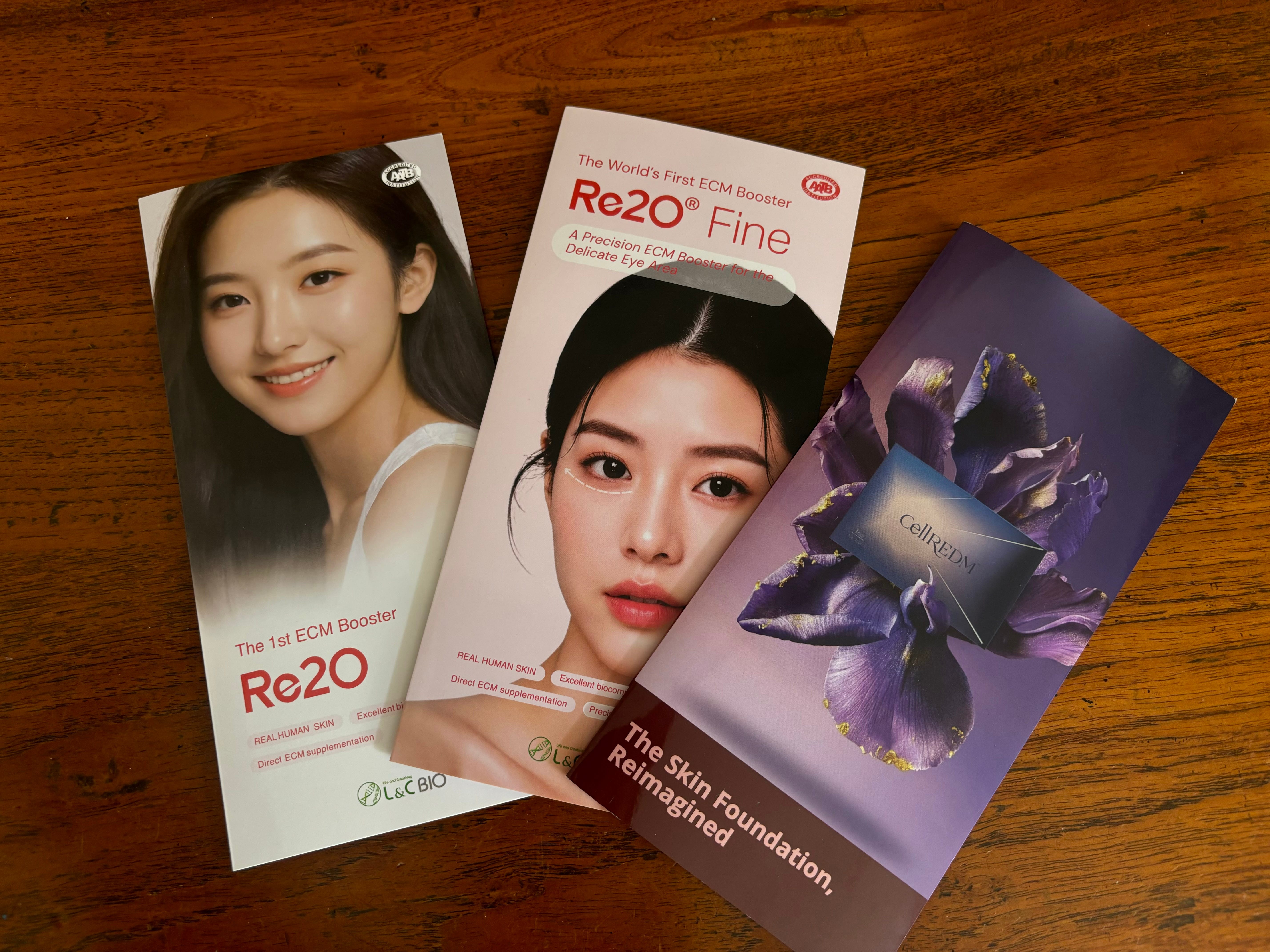
RE20 and RE20 Fine (a finer-particle version for thinner, more delicate areas like the undereyes), made by South Korean tissue-engineering company L&C Bio, landed at the end of 2025, followed more recently by CellREDM from HansBiomed, a South Korean tissue-engineering and medical-device company specialising in human tissue grafts and regenerative materials.
The appetite for human-derived regenerative treatments appears to be growing both here and abroad. Social media influencers are already enthusiastically documenting their treatments and results.
Meanwhile, L&C Bio is already developing another injectable using donated human adipose tissue, this time aimed at restoring facial changes associated with rapid weight loss, including the hollowing commonly dubbed “Ozempic face”.
As the use of donated human tissue in aesthetics gains popularity, however, it raises a more fundamental question: where, exactly, is all this tissue coming from? Both South Korean ECM manufacturers say their raw human dermal tissue is sourced from the US through regulated, ethical tissue-donation programmes.
But publicly available information does not identify the specific tissue banks or organisations supplying the dermis used in these injectables.
Those questions matter because the wider US non-transplant human tissue trade has faced scrutiny over gaps in oversight and cases involving consent and the handling of donated bodies. Bioethicist Dr Art Caplan has famously likened parts of the industry to the “Wild West”.
That doesn’t mean the same concerns necessarily apply to the tissue used in these products but it does make traceability worth examining.
So are cadaver-derived ECM skin boosters simply the next evolution of a well-established medical material, or does their arrival in aesthetics raise questions the industry still needs to answer?
I spoke to Dr Harvey Ho of Skinscape Clinic and Dr Rachel Ho of The Skin Longevity Clinic — both of whom offer ECM skin boosters at their clinic — about the ethics, science and safety behind this unusual new category of injectables.
1. The origins of the human tissue remain difficult to trace.
Dr Rachel Ho says the question of where the donor tissue comes from was raised at a press conference for one of the ECM products.
According to Ho, the manufacturers said the raw human tissue used to produce the ECM was obtained from the United States through regulated tissue-donation programmes. But when pressed for more specific information — including which tissue banks or organisations supplied the dermis — she says they declined to disclose further details.
GlowEdit.io’s own investigation managed to trace one apparent link in that supply chain to a San Antonio address belonging to BioBridge Global, a non-profit parent organisation whose entities include South Texas Blood & Tissue and GenCure, and whose work spans tissue donation, cellular therapies and regenerative medicine.
Public reviews from people describing their donation experiences at the organisation make no mention of South Korea or of donated tissue potentially entering the aesthetic industry overseas.
This does not establish what individual donors were told or consented to, but it raises a question central to this story: how much do donors know about where their tissue may ultimately end up, and how it may be used?
GlowEdit.io contacted BioBridge Global seeking clarification about its involvement in supplying human dermal tissue for ECM products. At the time of publication, the organisation had not responded.
2. It’s not new — but it is different
If ECM sounds like yet another addition to an increasingly crowded menu of skin boosters, both doctors argue that the comparison isn’t quite so straightforward.
Dr Harvey Ho sees ECM as an evolution rather than a radical new invention. Micronised human ADM was already being used for soft-tissue augmentation and scar correction more than a decade ago, he says, but earlier formulations were cumbersome to prepare, variable to handle and less predictable in longevity than newer fillers.
RE20, he says, takes that established biological concept and reformulates it specifically for skin rejuvenation and easier clinical use.
Rachel admits she was initially sceptical about ECM when she first encountered it. It was only after travelling to South Korea and trying the treatment herself that she became more interested in its potential, eventually introducing it to her own patients in Singapore.
Harvey took a similarly hands-on approach. Before introducing a new treatment into routine practice, he says he typically tries it on himself, where appropriate, as well as on willing test subjects.
For him, published evidence establishes whether a treatment is scientifically plausible, but seeing how it performs in practice helps answer other questions: which patients respond best, whether the results are reproducible and how it works alongside other treatments.
So far, he says he has been particularly impressed by RE20’s effects on overall skin quality, including among patients with sensitive or compromised skin.
Rachel has observed similarly visible results in her own patients. One possible explanation, she believes, is that a matrix derived from human dermis may more closely resemble the biological environment of human skin than animal-derived materials such as salmon PDRN or porcine collagen.
3. It can improve skin quality — but it can’t do everything
For all the excitement around ECM, both doctors caution against treating it as a cure-all.
“RE20 cannot treat volume loss, dynamic wrinkles, hyperpigmentation or active inflammatory conditions like acne and eczema,” says Rachel.
In other words, its role is primarily in improving skin quality, rather than replacing the treatments dermatologists and aesthetic doctors already use for specific concerns. It won’t restore lost facial volume like a filler, relax expression lines like botulinum toxin, or tackle pigmentation in the way certain lasers and topical treatments can.
Harvey is similarly cautious about overstating what ECM can currently achieve. While he considers RE20’s underlying mechanism scientifically credible, he cautions that “some of the marketing claims are more ambitious than the current evidence supports”.
“Gold threads are a classic example, they were heavily promoted for facial lifting, but long-term results were inconsistent, caused complications, and the threads could be difficult to remove or interfere with future procedures. There have also been many energy-based treatments that generated significant hype before robust clinical evidence was available,” he says.
Larger, independent studies with longer follow-up are still needed, he says, before doctors can determine exactly where RE20 belongs in aesthetic medicine.
4. The science — and the treatment — is still evolving
Even as ECM boosters make their way into clinics, doctors are still refining how best to use them.
Harvey says this is not unusual in medicine: clinical practice often develops alongside the research, as doctors gain experience with a treatment while larger and longer-term studies continue.
With injectable ECM, some surprisingly practical questions remain unresolved. What is the ideal injection depth? How far apart should treatments be spaced? Which particle formulation works best? And how should ECM be combined with lasers, energy-based devices or other injectables?
“We’re still refining the optimal treatment protocols,” says Harvey, pointing to injection depth, treatment intervals and particle formulation as areas that continue to be investigated.
There is also a bigger scientific question. Much of what is known about acellular dermal matrix comes from its long history in reconstructive and plastic surgery, where it has been used for wound healing and tissue repair. But injecting micronised ECM into otherwise healthy skin for rejuvenation is a different application.
“We’re still learning more about how findings from traditional acellular dermal matrix research translate to injectable ECM products,” Harvey says. While ADM’s biological properties are relatively well understood, he adds, injectable versions “are used differently, so it’s important that they continue to be studied specifically for such use.”
5. Long-term safety data is still limited
In Singapore, the products are approved by the Health Sciences Authority (HSA), something Rachel says gave her greater confidence after first encountering ECM boosters in South Korea.
But regulatory approval doesn’t answer every question about what might happen years down the line. As a human tissue-derived injectable, Rachel says the theoretical concerns include tissue-related biocompatibility and the transmission of infectious diseases.
“I don’t think I can give you a blanket answer about how many years, because emerging innovations often lack longer-term data,” she says. “But the product’s HSA approval made me more reassured about this after I first saw this in South Korea.”
Harvey also points to long-term immune response as an area where more evidence is needed. While he describes the safety profile to date as reassuring, he says researchers are still learning how different patients may respond immunologically over time.
So far, his own clinical experience has not given him cause for alarm. In fact, he says some patients with sensitive or compromised skin have experienced improvements in skin quality and resilience after treatment.
For Rachel, however, the absence of a concerning signal today isn’t a reason to stop watching.
“I’ll definitely be keeping tabs on the news and data of this category of products as they continue to emerge,” she says.


